
Diet Culture’s New Target: Perimenopause, Buzzwords, and the Latest Wellness Traps

Updated: Apr 6
If you spend any time online, you’ve probably noticed something lately.
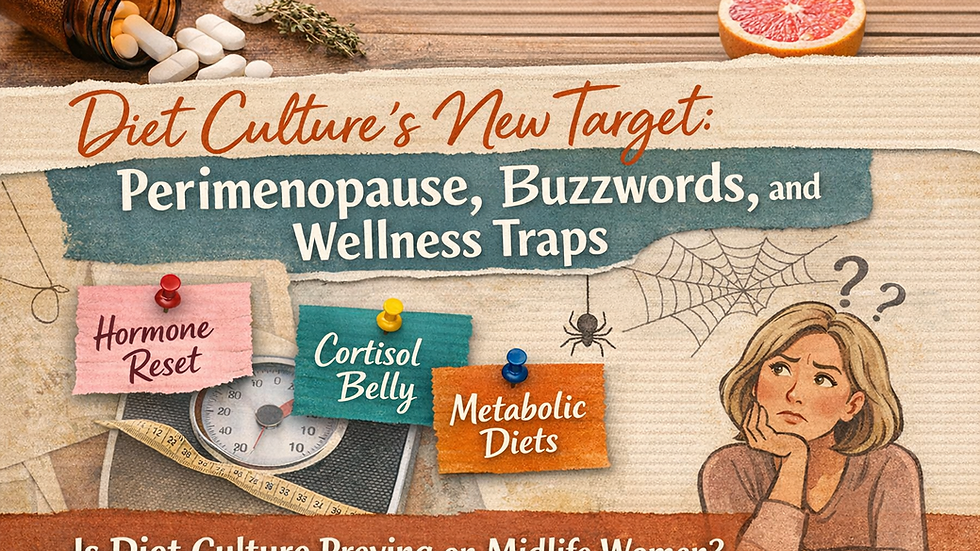
Suddenly, everyone seems to be talking about hormone resets, metabolic flexibility, cortisol belly, and menopause weight loss programs.
Social media is flooded with promises to help women in their 40s and 50s “fix” their bodies.
At first glance, these messages appear empowering. They often claim to support hormone health, longevity, or metabolic wellness.
But if you look a little closer, something becomes clear:
Diet culture hasn’t disappeared. It has simply rebranded itself.
And right now, one of its biggest targets is women experiencing perimenopause and menopause.
Diet Culture Never Disappears — It Reinvents Itself
Over the past few decades, we’ve seen countless diet trends come and go.
Low-fat.
Low-carb.
Keto.
Paleo.
Detoxes.
Juice cleanses.
Intermittent fasting.
Each one promises the same thing: a way to control our bodies and achieve health.
Now, many of these same ideas are being repackaged under new labels like:
hormone balance
metabolic optimization
anti-inflammatory eating
longevity nutrition
Instead of saying “lose weight,” the message now says:
“Balance your hormones.”
But often, the behaviors being promoted are exactly the same: restriction, elimination of food groups, and rigid rules around eating.
Why Diet Culture Is Targeting Perimenopause
Perimenopause is a time of natural transition in the body.
Women may experience changes such as:
hormonal fluctuations
shifts in body composition
changes in sleep patterns
mood changes
metabolic adjustments
These changes are normal parts of aging and biology.
But diet culture sees something else.
It sees fear and uncertainty.
When people feel uncomfortable or confused about their bodies, they are more likely to search for solutions.
And that’s where the marketing begins.
Suddenly, women are told their bodies are “broken” and need to be repaired with:
hormone-reset programs
menopause weight-loss systems
metabolic reboot plans
supplement stacks
The truth is that many changes during perimenopause are simply normal physiological processes, not personal failures that need fixing.
Buzzwords That Should Trigger Your “Spidey Senses”
Not every wellness professional is promoting harmful ideas. However, there are certain buzzwords that diet culture frequently uses to disguise restriction.
If you start hearing these phrases repeatedly, it may be worth taking a closer look.
Hormone Reset
Hormones are complex biological systems influenced by sleep, stress, nutrition, genetics, and aging.
They cannot be “reset” with a 21-day diet or program.
Metabolic Flexibility Programs
This term sounds scientific, but it often involves cutting carbohydrates, fasting longer, or restricting calories — behaviors that can actually slow metabolism, especially for chronic dieters.
Anti-Inflammatory Weight Loss
Reducing inflammation can be beneficial in some cases. However, many programs use the term to create fear around foods like bread, dairy, grains, or sugar — foods that can absolutely fit into a balanced diet.
Cortisol Belly
You may have heard the claim that belly fat is caused by “high cortisol.”
In reality, fat distribution naturally changes as hormones shift during midlife. There is no simple diet that eliminates so-called cortisol belly.
Detox
Your body already has a detox system: your liver, kidneys, digestive system, and lungs.
Juice cleanses and detox teas don’t improve this system. They mostly lighten your wallet.
Why These Trends Can Be Dangerous for Eating Disorder Recovery
For people recovering from disordered eating, these new trends can be particularly challenging.
That’s because they don’t look like diets anymore.
Instead, they present themselves as:
hormone health
longevity strategies
metabolic science
wellness optimization
But if a program includes (red flags):
rigid food rules
elimination of entire food groups
fear around normal eating
constant monitoring of food intake
Then it may simply be diet culture wearing a lab coat.
What Actually Supports Health During Midlife
When we look at long-term research on health, the recommendations are far less dramatic than what diet culture promotes.
Sustainable health practices often include:
eating regular, balanced meals
consuming a wide variety of foods
increasing fiber and plant diversity
adequate protein intake
joyful and consistent movement
quality sleep
social connection
stress management
These habits are not trendy or flashy.
But they are sustainable and supportive of long-term wellbeing.
Questions to Ask When You Hear a New Diet Trend
When you encounter a new diet trend, consider asking yourself:
Does this plan eliminate entire food groups?
Does it promise fast or dramatic results?
Does it require strict rules around eating?
Does it make me feel fear or guilt around food?
Does it encourage listening to my body, or ignoring it?
If the program encourages rigidity, fear, or restriction, your intuition may already be telling you something important.
Embracing the Changes
Perimenopause and menopause are natural transitions, not problems that need to be fixed.
Your body is not broken.
It is changing, adapting, and continuing to support you in countless ways.
Instead of chasing the newest wellness trend, the path toward sustainable health often looks much simpler: variety, balance, nourishment, and compassion for your body.
Your body deserves care, not control.
Finding Peace with Food
As you navigate these changes, remember that healing your relationship with food is possible.
You can embrace a lifestyle that prioritizes your well-being over societal expectations.
Focus on what feels good for you.
Listen to your body.
Allow yourself to enjoy food without guilt.
This journey is about discovering what nourishes you, both physically and emotionally.
You are not alone in this.
Many are on a similar path, seeking peace and freedom around eating.
Together, we can break free from the cycle of diet culture and reclaim our bodies.
Let’s choose compassion over criticism, understanding over judgment.
Your journey is unique, and it deserves to be honored.
By prioritizing your health and well-being, you can cultivate a life filled with joy, balance, and nourishment.
Embrace this opportunity for growth and transformation.
You are worthy of love and acceptance, just as you are.
Let’s move forward together, celebrating our bodies and the incredible journey they take us on.


Comments